Aurora Map
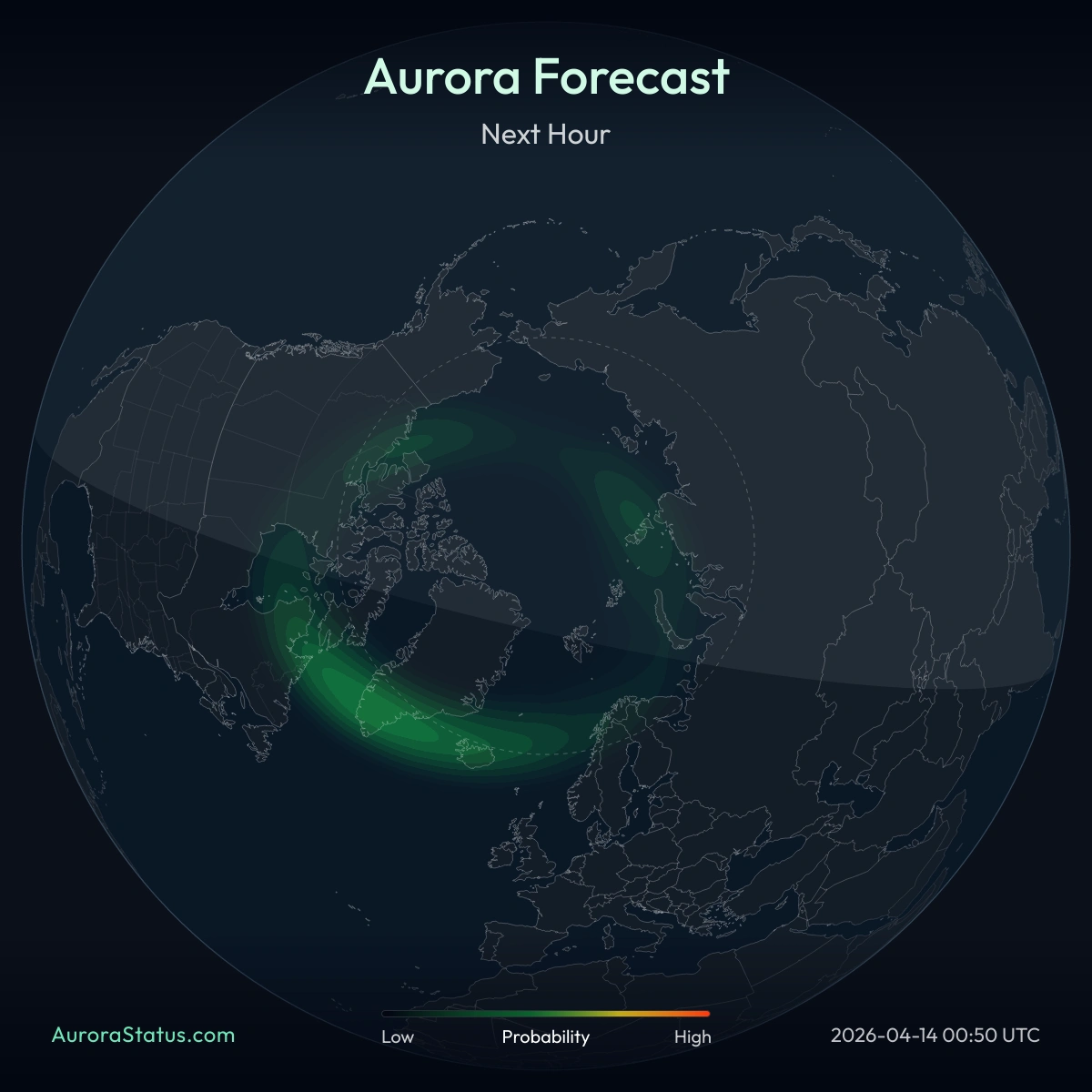
See 1-hour northern lights forecast on a beautiful map. This map is automatically updated every 5 minutes and you can add it to your website with a simple image embed.
Long-Term Aurora Forecast
| Mon | Tue | Wed | Thu | Fri | Sat | Sun |
|---|---|---|---|---|---|---|
Wednesday, September 2, 2026. Today. No aurora activity. Estimated Kp index 1.3. Waning gibbous, 70% illumination | Thursday, September 3, 2026. No aurora activity. Estimated Kp index 1.3. Last quarter, 60% illumination | Friday, September 4, 2026. No aurora activity. Estimated Kp index 1.3. Last quarter, 48% illumination | Saturday, September 5, 2026. No aurora activity. Estimated Kp index 1.3. Last quarter, 37% illumination | Sunday, September 6, 2026. Low aurora activity. Estimated Kp index 2.4. Waning crescent, 26% illumination | ||
Monday, September 7, 2026. Low aurora activity. Estimated Kp index 2.6. Waning crescent, 17% illumination | Tuesday, September 8, 2026. Low aurora activity. Estimated Kp index 2.1. Waning crescent, 9% illumination | Wednesday, September 9, 2026. No aurora activity. Estimated Kp index 1.3. New moon, 3% illumination | Thursday, September 10, 2026. No aurora activity. Estimated Kp index 1.3. New moon, 1% illumination | Friday, September 11, 2026. No aurora activity. Estimated Kp index 1.3. New moon, 0% illumination | Saturday, September 12, 2026. Low aurora activity. Estimated Kp index 2.1. New moon, 2% illumination | Sunday, September 13, 2026. Low aurora activity. Estimated Kp index 3.0. Waxing crescent, 6% illumination |
Monday, September 14, 2026. Low aurora activity. Estimated Kp index 2.6. Waxing crescent, 12% illumination | Tuesday, September 15, 2026. Low aurora activity. Estimated Kp index 2.1. Waxing crescent, 20% illumination | Wednesday, September 16, 2026. Low aurora activity. Estimated Kp index 2.1. Waxing crescent, 28% illumination | Thursday, September 17, 2026. No aurora activity. Estimated Kp index 1.3. First quarter, 37% illumination | Friday, September 18, 2026. No aurora activity. Estimated Kp index 1.3. First quarter, 47% illumination | Saturday, September 19, 2026. No aurora activity. Estimated Kp index 1.3. First quarter, 56% illumination | Sunday, September 20, 2026. No aurora activity. Estimated Kp index 1.3. First quarter, 65% illumination |
Monday, September 21, 2026. No aurora activity. Estimated Kp index 1.3. Waxing gibbous, 74% illumination | Tuesday, September 22, 2026. No aurora activity. Estimated Kp index 1.3. Waxing gibbous, 82% illumination | Wednesday, September 23, 2026. No aurora activity. Estimated Kp index 1.3. Waxing gibbous, 89% illumination | Thursday, September 24, 2026. Low aurora activity. Estimated Kp index 2.4. Waxing gibbous, 95% illumination | Friday, September 25, 2026. Low aurora activity. Estimated Kp index 2.1. Full moon, 98% illumination | Saturday, September 26, 2026. No aurora activity. Estimated Kp index 1.3. Full moon, 100% illumination | Sunday, September 27, 2026. No aurora activity. Estimated Kp index 1.3. Full moon, 99% illumination |
Monday, September 28, 2026. No aurora activity. Estimated Kp index 1.3. Waning gibbous, 96% illumination | Tuesday, September 29, 2026. No aurora activity. Estimated Kp index 1.3. Waning gibbous, 90% illumination |
Aurora Basics
Northern Lights FAQ
What are the Northern Lights?
The Northern Lights, or aurora borealis, are natural light displays caused by charged particles from the Sun interacting with Earth’s magnetic field and upper atmosphere. Those particles excite gases high above the planet, creating the glowing ribbons, arcs, and curtains seen in the night sky.
When is the best time to see the Northern Lights?
Auroras happen year-round, but you can only see them when the sky is dark enough. In northern destinations, the main viewing season usually runs from late August or September to early April, and activity is often strongest around midnight and the hours just before and after.
What gives me the best chance of seeing them?
Your best odds come from combining three things: a northern location, a clear sky, and as little artificial light as possible. The aurora is most commonly seen under the auroral oval at high latitudes, and even a strong display can be harder to spot if clouds, city lights, or a bright full moon wash out the sky.
Where are the best places to travel for the Northern Lights?
If you want the easy answer: northern Finland is hard to beat. Saariselka, Levi, Rovaniemi, Kilpisjarvi, and Utsjoki all give you a strong mix of high latitude, dark skies, and visitor-friendly infrastructure. Outside Finland, places like Tromso, Alta, and Reykjavik are also popular bases, but Finland usually wins on the balance of access, lower light pollution, and reliable inland conditions.
Can you see the Northern Lights with the naked eye?
Yes, absolutely. Strong auroras are clearly visible to the naked eye, but faint displays may look softer or less colorful than the photos you see online because cameras can capture more light and color detail than human night vision can.
Why are the Northern Lights different colors?
Different colors come from different gases in Earth’s atmosphere and the altitude where the interaction happens. Green is the most common color, while red, blue, purple, and pink can appear when particles energize oxygen and nitrogen at different heights.
How accurate are aurora forecasts?
Aurora forecasts are useful, but they are not guarantees. NOAA’s short-term aurora forecast is based on a model with roughly 30 to 90 minutes of lead time, and broader forecasts often use the Kp index to estimate geomagnetic activity, but local weather, darkness, and your exact location still make a big difference in whether you actually see anything.
Do I need a very strong aurora forecast to see them?
Not always. If you are already in a good high-latitude location under dark, clear skies, you can sometimes see beautiful auroras even when geomagnetic activity is relatively modest, especially in places like Saariselka, Kilpisjarvi, Utsjoki, or Tromso. Bigger storms help, especially farther south, but clear skies and the right location matter just as much.
Popular Aurora Locations
Check out the northern lights forecast for some of the most popular aurora spotting locations around the world.